

Artificial Intelligence Can Reduce Camera Trap Analysis Time and Benefit Conservation
Using AI to identify animals in images shows promise when used with occupancy models
Human review of camera-trap images often requires months of human-led analysis time to accurately identify animals. In a recent study published in the Journal of Applied Ecology, Daniel Thornton and colleagues tested the ability of models to predict animal presence using images from artificial intelligence (AI) species classification models against human-expert species identifications. Results showed the models produced similar predictions for most species for both AI and human-expert identifications.
Camera trapping is a widely used wildlife survey technique in which motion-sensitive cameras are placed in the landscape to record images of wildlife that trigger the camera’s sensor. Over time, camera-trap networks can generate millions of images, which require extensive, time-consuming analysis. Time spent analyzing camera-trap images can become a significant obstacle, raising labor costs, increasing the time required to complete the analysis, and extending the timeline for using the data to make conservation decisions.
Because of the long analysis times, artificial intelligence is seen as a potential transformative technology to reduce the time required to analyze camera-trap images. However, as artificial intelligence is increasingly used in the analysis pipeline, there are concerns about AI’s ability to accurately identify species and use those identifications to make ecological inferences.
Thornton and colleagues set out to compare the results of occupancy models using both AI-based and human-expert animal identifications. If model results are similar using both AI and human-expert identifications, that is notable, even if AI misidentifies some animals. Reduced data processing could be critical for underfunded studies or enable researchers to expand monitoring to larger areas.
How was the camera trapping study done?
In this study, researchers compared occupancy models using AI and human-expert identifications from nearly 3.8 million camera-trap images. Occupancy modeling is a fairly coarse population metric, as it represents only presence or absence rather than more specific metrics such as abundance and density. Given the coarse nature of occupancy, researchers hypothesized that any imperfections in the AI identifications would not affect the results of the occupancy models compared to those using human-expert identifications.
Researchers collected camera-trap images from three study sites in North America: Washington, Montana, and Guatemala. After using a program called MegaDetector to identify images with animals, the researchers used SpeciesNet to classify the animal targets to species. Several AI datasets were created from the images, each with different processing steps in the analysis pipeline. Human experts also identified animals in a subset of the images. Afterward, the researchers conducted occupancy modeling using AI- and human-expert datasets to compare the model outputs. The researchers also looked at the accuracy of identifications between AI and human experts.
What were the study’s findings?
Model results using AI identifications were similar to those using human-expert identifications in both parameter estimates and the direction of the relationship between variables and occupancy (positive or negative). The models’ occupancy predictions were also similar for most species; however, predicted occupancy for bobcats in Montana and margays in Guatemala differed substantially between models using AI vs. human-expert identifications.
When the researchers compared the animal identifications directly, they found high true-positive rates >80% and low false-negative rates <10%. For most species, false positive rates were <15%, but were >35% for elk in Washington, bobcats in Montana, and white-tailed deer in Guatemala.
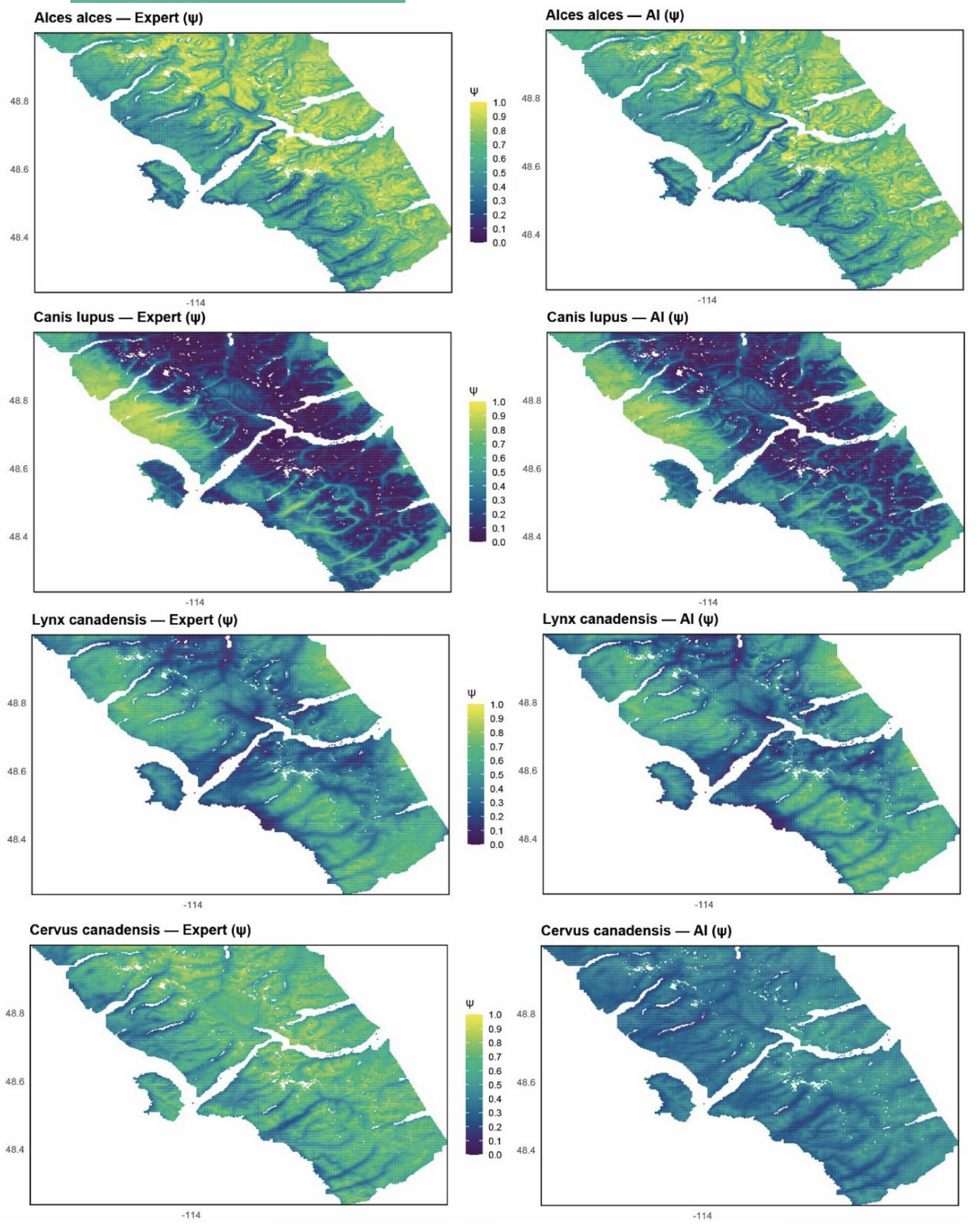
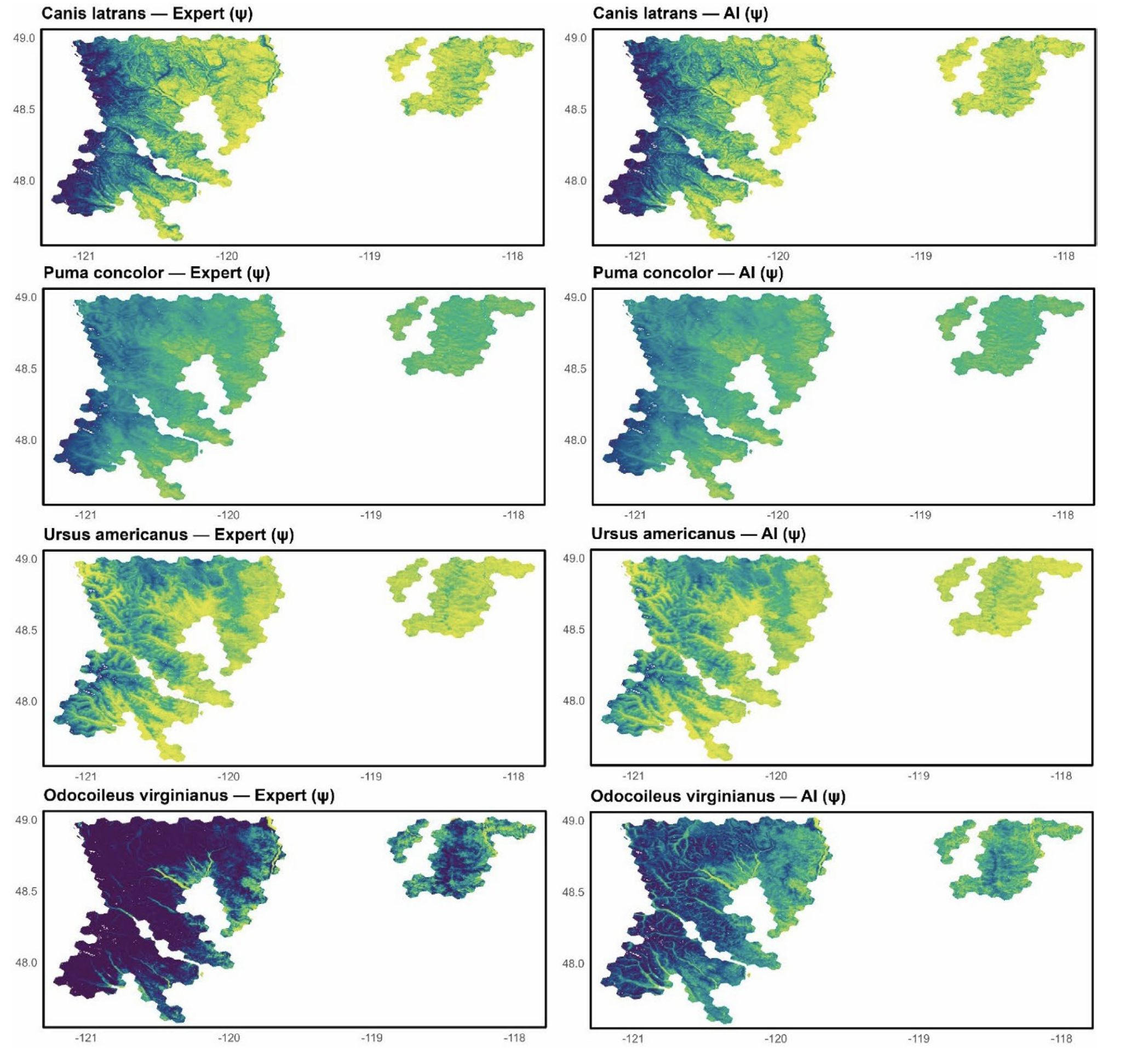
When the occupancy models were used for mapping, most maps were similar for models using AI and human-expert identifications. The maps that were notably different included elk (Figure 1) and white-tailed deer (Figure 2) in Washington, elk and bobcats in Montana, and tayra and white-tailed deer in Guatemala.
Conclusions
Findings from this study suggest that removing humans from the image analysis pipeline is practical when using the data for occupancy models. The advantages of using an all-AI workflow for image analysis include reduced processing time, lower costs, and faster dissemination of results for decision-making. Despite AI identifications being imperfect (false negatives and false positives), the results of using these identifications with occupancy models were similar to those obtained using human-expert identifications.
While other research has suggested that false positives negatively impact occupancy models, results from this study suggest that occupancy models may be resistant to false positives up to about a 20% rate. Above 20%, the occupancy predictions and effect sizes using AI identifications start to diverge substantially from those of the human-expert identifications. The authors suggest this could be due to high sample sizes in this study, or their use of occupancy models across species (opposed to species-specific models), or the coarse nature of occupancy modeling is more robust to misidentifications. Despite the promising findings, the researchers caution that other types of modeling for abundance or density, which require very accurate counts, may not perform as well using AI identifications. Researchers using camera trapping should focus more on developing accurate statistical models than on achieving near-perfect agreement between AI and human experts.
Despite the advantages of AI in camera-trap analysis, human reviewers remain valuable for identifying similar and rare species for which there is little training data to inform AI classifiers. Consequently, the application of a fully automated workflow using AI will be difficult for studies focusing on rare or similar species. Most species in this study were medium to large mammals, and it is unknown whether these results can be extrapolated to studies of smaller mammals or other terrestrial wildlife.
The reductions in cost and analysis time in camera-trapping studies enabled by AI identification could allow scientists to expand future studies to the regional level or to reduce analysis time for the currently scoped projects. In fact, larger-scale studies may benefit the most from this approach, given the often limited funds and frequent need for rapid decision-making when implementing conservation actions.
References
Royle, J. A., & Link, W. A. (2006). Generalized site occupancy models allowing for false positive and false negative errors. Ecology, 87(4), 835–841. https://doi.org/10.1890/0012-9658(2006)87[835:GSOMAF]2.0.CO;2
Thornton, D., D. Morris, T. King, L. Perera-Romero, A. Anderson, R. Garcia-Anleu, S. Fitkin, and C. Vynne. 2026. Identification of camera trap images by artificial intelligence and human experts produces similar multi-species occupancy models. Journal of Applied Ecology 63:e70370. https://doi.org/10.1111/1365-2664.70370


Comments ()