

New Monitoring Technologies Show Low Bird Collision Risks at Offshore Wind Farms
New radar and camera technologies show birds at low risk of collision with offshore wind turbines

A new study using radar and cameras at an offshore wind farm found that birds avoided wind turbines at a very high rate, suggesting that collision risk is likely much lower than previously thought.
Bird collisions with wind turbines are a common concern among scientists, regulators, and the public. Given the difficulty of studying bird behavior offshore, many assumptions about collision risks have been made based on observations outside wind farms and from onshore wind farms, rather than from direct offshore observations. These assumptions are likely flawed given the growing evidence that avoidance behavior is highly species-specific and that data on avoidance need to be collected at the species level and within offshore wind farms to apply to understanding offshore collision risks. However, collecting data offshore is challenging due to the environment’s inaccessibility and the lack of automated detection and tracking tools for following birds across large areas.
Recent advances in radar and pan-tilt-zoom camera technologies enable tracking of seabird behaviors at large scales within wind farms at the species level. Researchers Henrik Skov and colleagues from Denmark and the United Kingdom published a study in the Journal of Applied Ecology where they used radar and cameras at an offshore wind farm to collect seabird flight behavior data to better understand meso-avoidance (avoiding individual turbines) and micro-avoidance (avoiding the blades if in proximity to a turbine) behaviors. They also examined bird behavior in relation to wind speed and air turbulence.
How was the study done?
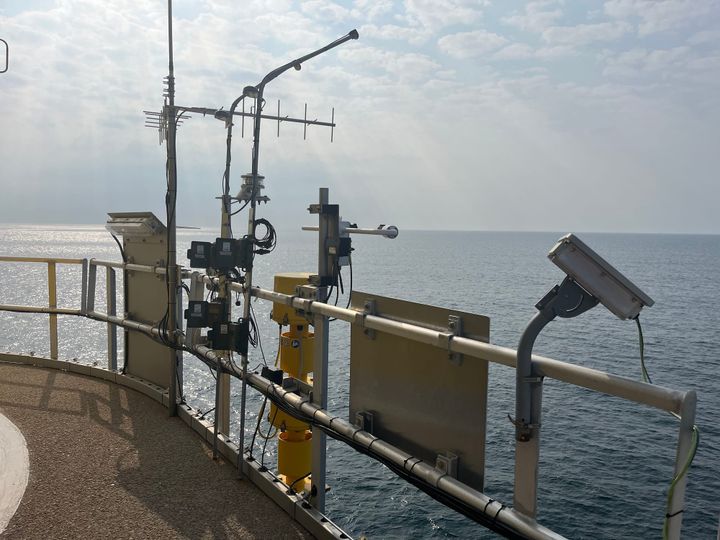
Researchers deployed an integrated radar and camera tracking system at the 11-turbine Aberdeen Offshore Wind Farm of Vattenfall off the coast of northeast Scotland during the breeding season in 2020 and 2021. The system captured 3D seabird tracks and estimated flight heights by triangulating the radar and camera for each track. In each case, the radar detections would trigger the camera to record birds, but the camera could only track one target at a time. Tracks of larger birds, including northern gannet, large gulls, and black-legged kittiwake, could be recorded out to 3 km from the radar. The visible-light camera could record medium-sized birds to 1 km and large seabirds out to 2 km. Researchers also evaluated the influence of wind speed and wind direction on seabird avoidance behavior using a random forest statistical model.
What did the study find?
Researchers found that birds tended to avoid areas near the turbines and favored the airspace between turbine rows (meso-avoidance), with Herring Gulls and Black-legged Kittiwakes showing this behavior. For other species, such as northern gannets and great black-backed gulls, the data were less definitive, with both showing some avoidance behavior. Less than 2% of the 9,998 target birds in the videos flew in proximity to the blades, and 67% of those birds adjusted their flight and flew along the plane of the blades (micro-avoidance). Only 5 of the 180 birds close to the blades did not adjust their flight path; no collisions were observed in the entire study.
Skov and colleagues also noted that all species showed a noticeable decrease in flight speed as they approached the turbine blades. However, in the presence of air turbulence, decreases in flight speed were often not observed.
Conclusions
This study showed high levels of micro-avoidance (>96%) for all species of interest. The researchers noted that air turbulence strongly affected the flight patterns of target birds and that the ability of birds to reduce their speed when approaching wind turbines is reduced during strong winds and greater air turbulence. Under these conditions, birds are subject to sensory and energetic constraints that they don’t experience during calmer weather. Another study noted similar trends with black-legged kittiwakes from GPS data. However, under most weather conditions, the collision risk at offshore wind facilities is likely very low.
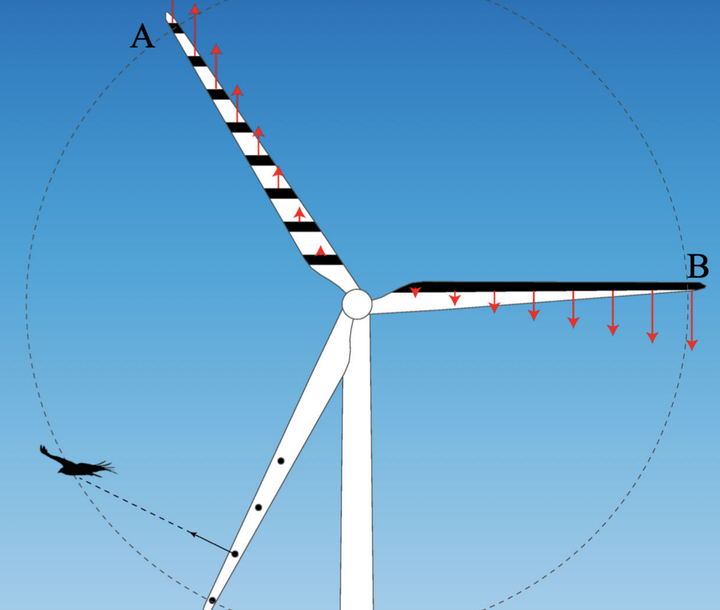
The fact that only 5 of 180 birds showed no change in flight path when in proximity to the blades is also poignant. The Band Collision Risk Model, commonly used to predict collision mortality at offshore wind facilities, assumes that birds cross the blades perpendicularly; however, the data from this study show that this assumption is frequently violated. The Band Model also assumes fixed avoidance rates and flight speeds, and this study found neither. Thus, it is likely that collision risks predicted by the Band Model are inflated, perhaps substantially. The researchers urge that future applications of collision risk models use spatially explicit data alongside behavioral information rather than fixed inputs.
The study results are encouraging, as collision risk to birds at offshore wind facilities is likely very low. However, the study did not examine behaviors during the night, a period when many seabirds and migratory passerines are active, so it is not known to what extent these findings apply to nocturnally active birds. In addition, the cameras could only track one target at a time, so behavior in flocks is poorly understood. This study also examined only a few species of seabirds and did not consider landbirds that use ocean waters, such as raptors and passerines.
Despite the limitations, this study provides empirical data on bird collision rates with wind turbines, which is a far superior approach to using risk models with questionable assumptions and limitations to do the same thing. A collision risk model based on empirical behavioral data would be more useful than one that uses fixed, theoretical values for avoidance rates and flight speeds.
References
Davies, J. G., Boersch-Supan, P. H., Clewley, G. D., Humphreys, E. M., O'Hanlon, N. J., Shamoun-Baranes, J., Thaxter, C. B., Weston, E., & Cook, A. S. C. P. (2024). Influence of wind on kittiwake Rissa tridactyla flight and offshore wind turbine collision risk. Marine Biology, 171(10), 191. https://doi.org/10.1007/s00227-02404508-0
Dierschke, V., R. W. Furness, and S. Garthe. 2016. Seabirds and offshore wind farms in European waters: avoidance and attraction. Biological Conservation 202:59–68. https://www.sciencedirect.com/science/article/abs/pii/S0006320716303196
Skov, H., R. S. Tjørnløv, M. Armitage, M. Barker, J. B. Jørgensen, L. O. Mortensen, and T. Uhrenholdt. 2025. High-resolution multi-sensor technology reveals low collision risk to seabirds in offshore wind farms. Journal of Applied Ecology. https://doi.org/10.1111/1365-2664.70239


Comments ()