

Painting wind turbine blades with alternate patterns could reduce bird deaths
Painting different patterns on wind turbine blades could reduce bird collisions.
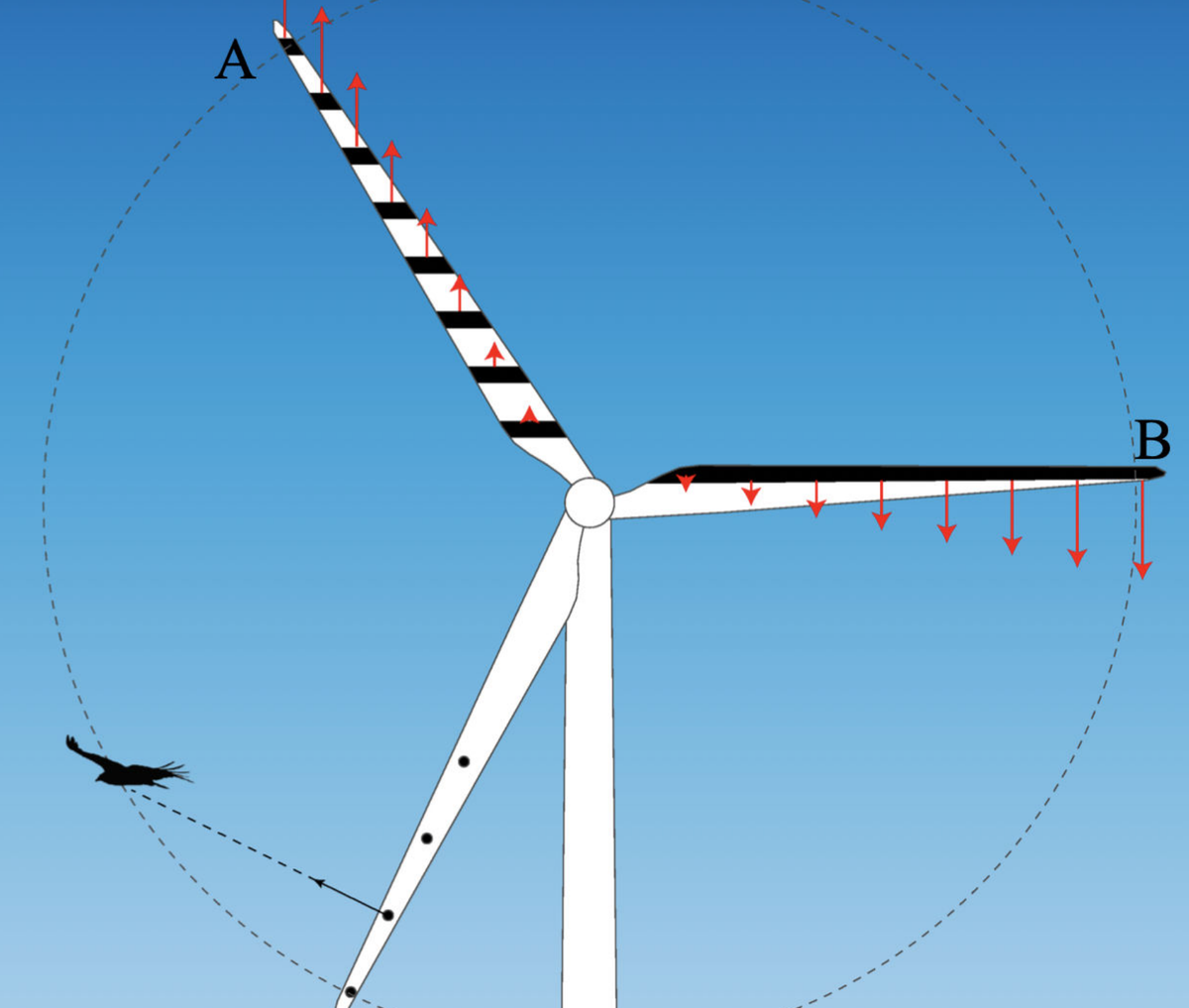
Researchers from the British Trust for Ornithology and Oxford University suggest using our understanding of bird vision to inform how to paint wind turbine blades to reduce collision fatalities, in a new study published in the Journal of the Royal Society Interface.
Why bird collisions are important
Bird collisions are common at wind farms and occur when birds get too close to spinning turbine blades and are unable to avoid them. Large soaring birds, such as raptors and gulls, may be particularly vulnerable to collisions because they use the same energy resource as turbines to facilitate soaring and are often co-located in high-wind areas. Birds see the world differently from humans, and understanding these differences can help develop creative solutions to reduce blade collisions.
While birds are very good at avoiding collisions in cluttered habitats like forests, structures that move, such as wind turbines, seem more difficult to avoid. Despite the threats posed by wind turbine collisions, there is widespread evidence that birds successfully avoid turbines most of the time. There are some mass-collision events associated with atmospheric conditions and poor visibility, such as fog. However, outside these large mass-mortality events, it is largely unknown why birds fail to avoid turbines in the isolated instances where a collision occurs.
Previous research has examined the effectiveness of wind turbine curtailment, in which blade spinning is stopped to reduce collision risk. These curtailment studies indicate that rotating blades pose a greater hazard than non-moving blades. It is unclear whether the increased hazard of moving blades is due to motion smear, difficulty recognizing the blades as a threat, or limited time to respond to blade impact.
Researchers Brighton and colleagues suggest in this new study that the current visual design of turbines is unlikely to be optimal for birds to avoid collisions. Thus, changing blade patterns to a design rooted in birds’ visual physiology could represent a promising approach to reducing bird collisions around wind energy facilities.
Recommended ways to improve wind turbine visibility for birds
The researchers recommend modifying the appearance of wind turbines to make them: easier to see, easier to perceive as a hazard, and easier to respond to effectively avoid them. Two studies at the Smøla Wind Farm in Norway have shown reduced collision impacts on raptors and some evidence of collision reductions in ptarmigans, but the authors suggest the painting used in these two studies to improve visibility was likely not optimal, based on what is known about bird vision.
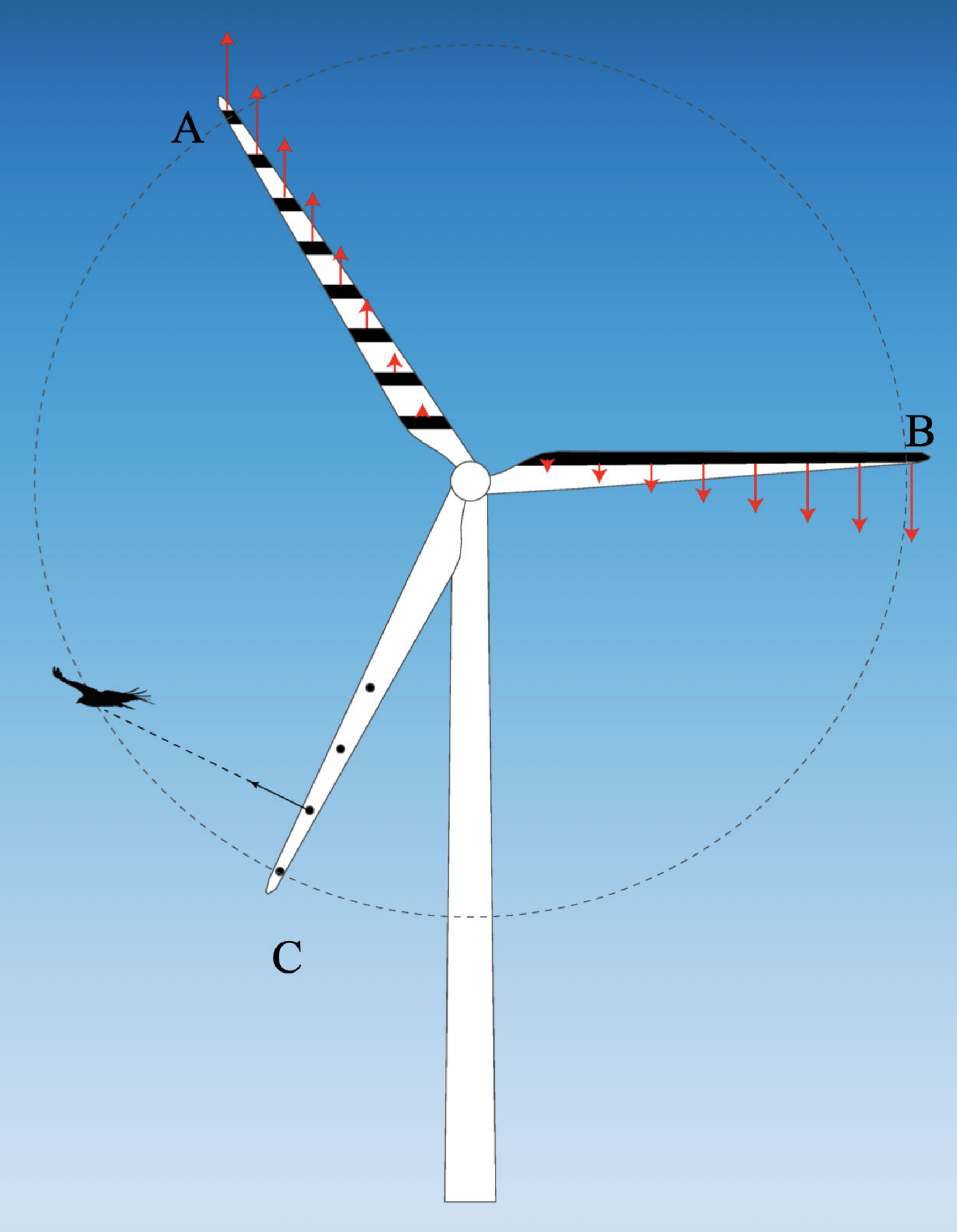
To improve blade visibility, the authors recommend several different types of painting. Diagonal stripes would increase visibility by varying their orientation along the blade's length and make them more visible across multiple background types. Using non-uniform patterns such as radial or fractal designs with repeating patterns could make it easier for birds to detect turbine blades (Figure 1). Patterns could also be painted in different colors to test for differences in effectiveness.
The authors recommend starting tests with laboratory experiments and testing the most effective designs in field trials. In addition to collision reduction, it would be useful to understand how different blade patterns influence bird approach angles, maneuverability responses, and avoidance behavior.
Limitations of wind turbine blade painting
The study by Brighton and colleagues discussed here is largely a literature review focusing on bird collisions, blade painting, and the bird visual system in relation to how birds perceive objects in their environment. The study follows with recommendations for blade painting based on what is known from the scientific literature. The paper did not conduct an actual experiment with new data on blade patterns to enhance visibility for birds.
In addition, blade painting has practical and logistical limitations to implement at wind facilities. Painting portions of the blade black could change its thermodynamics and increase its weight due to the added paint. Developers will also need to consider the potential visual effects of blade painting on humans, the effects on aviation regulations, and the mechanical effects of paint on the blades. Logistical challenges are also likely and include accommodating the lead times for procuring, preparing, and applying the paint on the blades. All of these factors could limit the application of blade painting if many developers are hesitant to use it.
Finally, blade painting may not be as effective as the two studies from Smøla suggest. Arecent study from the Netherlands tested a single black bait blade painted on seven wind turbines and found no reductions in gull collision rates. This contradictory finding from those at Smøla suggests that blade painting may reduce collisions only in certain species or geographic areas. Thus, more data are needed to determine how and why blade-painting effectiveness varies across locations and species.
References
Brighton, C. H., S. J. Portugal, and G. K. Taylor. 2026. Bio-informed blade patterns for mitigating bird collisions with wind turbines. Journal of The Royal Society Interface 23:20250719. https://doi.org/10.1098/rsif.2025.0719
Hüppop O., K. Hüppop, J. Dierschke, and R. Hill. 2016. Bird collisions at an offshore platform in the North Sea. Bird Study 63, 73–82. https://doi.org/10.1080/00063657.2015.1134440
Kleyheeg-Hartman J. C., S. K. Jeninga, E. F. Kappers, and E. Klop. 2023. Research into the effects of black rotor blades on bird collisions at Eemshaven. Waardenburg Ecology & Altenburg & Wymenga Ecologisch Onderzoek https://waardenburg.eco/en-gb/project/research-the-effects-of-black-rotor-blade
May R., T. Nygård, U. Falkdalen, J. Åström, Ø. Hamre, and B. G. Stokke. 2020 Paint it black: efficacy of increased wind turbine rotor blade visibility to reduce avian fatalities. Ecology and Evolution 10, 8927–8935. https://doi.org/10.1002/ece3.6592)
McClure C. J .W., B. W. Rolek, L. Dunn, J. D. McCabe, L. Martinson, and T. E. Katzner. 2022 Confirmation that eagle fatalities can be reduced by automated curtailment of wind turbines. Ecol. Solutions Evid. 3, e12173.https://doi.org/10.1002/2688-8319.12173
Stokke, B. G., T. Nygård, U. Falkdalen, H. C. Pedersen, and R. May. 2020 Effect of tower base painting on willow ptarmigan collision rates with wind turbines. Ecology and Evolution. 10, 5670–5679. https://doi.org/10.1002/ece3.6307



Comments ()