

Using two billion bird observations, radar, and artificial intelligence to track bird migration
eBird citizen science, AI, and radar data can predict population-level bird migration

Citizen science, radar technology, and artificial intelligence (AI) are being used to track bird migration at the population level of individual species, which was not previously possible. Understanding the population-level movements of migratory birds is critical for targeting conservation and management actions to the locations and times when they will have the most benefit.
Background
Scientists have long used radar to track bird migration over continental scales. However, this technology has one major limitation: you can’t tell which bird species are migrating from radar data alone. New research published in Global Ecology and Biogeography and Movement Ecology shows results from using data from billions of eBird observations, combined with AI, to predict bird migration.
Researchers at the University of Illinois and Cornell University built a new tool called BirdFlow that lets scientists track species-specific migratory movements using a predictive model fitted with the BirdFlowR software package. This tool calculates the BirdFlow Migration Traffic Rate, which is an estimate of the migration traffic rate of individual bird species across North America.
BirdFlow successfully identified major patterns and species-specific migratory routes, even in places with gaps in radar coverage. The tool accomplished this by inferring the population-level movements across a species’ range using data from the eBird Status and Trends project.
Researchers validated and tuned the models using separate datasets, including GPS tracks, banding recoveries, and radio telemetry data from the Motus Wildlife Tracking System. In fact, even a small amount of tuning data meaningfully improved the predictions.
Over 95% of the total activity included nocturnally migrating songbirds; waterfowl were <2% of the activity, and other species groups were even smaller. Fall migration showed a higher intensity than spring migration, and the peak activity shifted east in fall compared to spring.
Migration in both spring and fall showed a high density of migratory birds funneling through the Gulf of Mexico-Yucatán Peninsula route. Data also showed a high-intensity route connecting Louisiana, Kansas, and Alaska, between the Rockies and the Great Lakes. These areas include the Mississippi and Atlantic Flyways, which are known corridors for long-distance migratory songbirds.
Birds were also concentrated along the southern boundary of the boreal forest in southern Canada and the northern United States. This region is an important breeding area for songbirds and supports half of North American bird species.
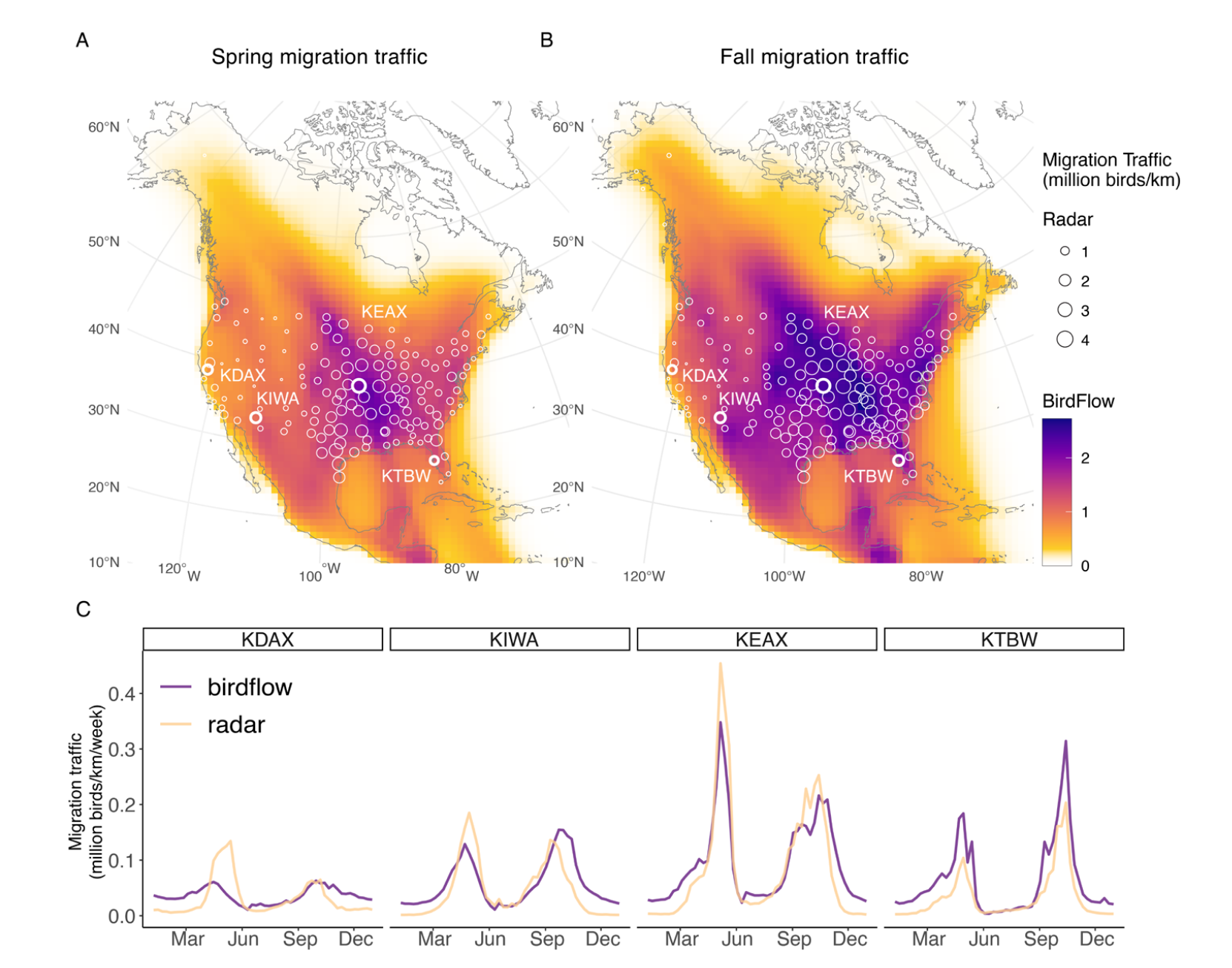
Advanced AI models combined with massive citizen science datasets and radar data are critical tools for understanding large-scale bird migration. These migration tools can aid species conservation, disease surveillance, aviation risk assessment, and public outreach.
References
Blancher, P. 2003. The Importance of Canada's Boreal Forest to Landbirds. Canadian Forest Service Ottawa. https://www.borealbirds.org/publications/importance-canadas-boreal-forest-landbirds
Chen, Y., D. L. Slager, E. Plunkett, M. Fuentes, Y. Deng, S. A. Mackenzie, L. E. Berrigan, D. Fink, D. Sheldon, B. M. Van Doren, and A. M. Dokter. 2026. Population-level migration modeling of North America’s birds through data integration with BirdFlow. Movement Ecology 14:46. https://link.springer.com/10.1186/s40462-026-00651-z
La Sorte, F. A., D. Fink, W. M. Hochachka, et al. 2014. “The Role of Atmospheric Conditions in the Seasonal Dynamics of North American Migration Flyways.” Journal of Biogeography 41, no. 9: 1685–1696. https://onlinelibrary.wiley.com/doi/10.1111/jbi.12328
Plunkett, E., Y. Deng, D. L. Slager, M. Fuentes, Y. Chen, B. M. V. Doren, A. M. Dokter, and D. Sheldon. 2026. Novel Estimates of Bird Migration Traffic at the Continental Scale Using Participatory Science Data. Global Ecology and Biogeography 35:e70236. https://onlinelibrary.wiley.com/doi/10.1111/geb.70236




Comments ()